Reading the Damage Before Spending Anything
Almost every replacement conversation starts in the wrong place — with a total — when it should start with a diagnosis. There are only two categories of problem in a paved surface, they cost very different amounts to resolve, and they can be told apart from a standing position by anyone willing to look carefully for ten minutes.
Signs that the trouble is only on top
Fine lines running roughly parallel to one another, often along the direction of travel, are usually the material aging rather than the ground failing. A surface that has gone gray, dry and slightly open in texture is showing its age, not its structure. Narrow openings that have not spread sideways into a network are still in the category where sealing is worth paying for. So is a surface that feels uniformly firm underfoot everywhere.
Damage in this category does not get better on its own, but it does respond to relatively inexpensive work, and postponing it is what moves it into the second category.
Signs that the ground has stopped carrying the load
Interlocking cracking that resembles scales or a dried riverbed is the clearest of them. Sponginess is another: an area that gives slightly when a vehicle rolls over it, or that feels different underfoot from the material around it. Depressions that hold water after rain belong here too, and so does the single most reliable indicator of all — an opening that has been closed, properly, and has come back along exactly the same line.
That last one is worth dwelling on, because it is the one that gets misread most often. A reopening in an identical position is not a failure of the sealant. It is a message that something below is still moving, and no amount of material applied to the top of it will quiet the movement underneath.
The test that settles it
Everything above reduces to a single question: is the material beneath still supporting weight? Where the answer is yes, a resurface or a set of repairs is good money. Where the answer is no, anything spent on the surface is spent on the symptom, and it buys a season or two at close to the price of doing the job properly.
What a Genuine Rebuild Contains
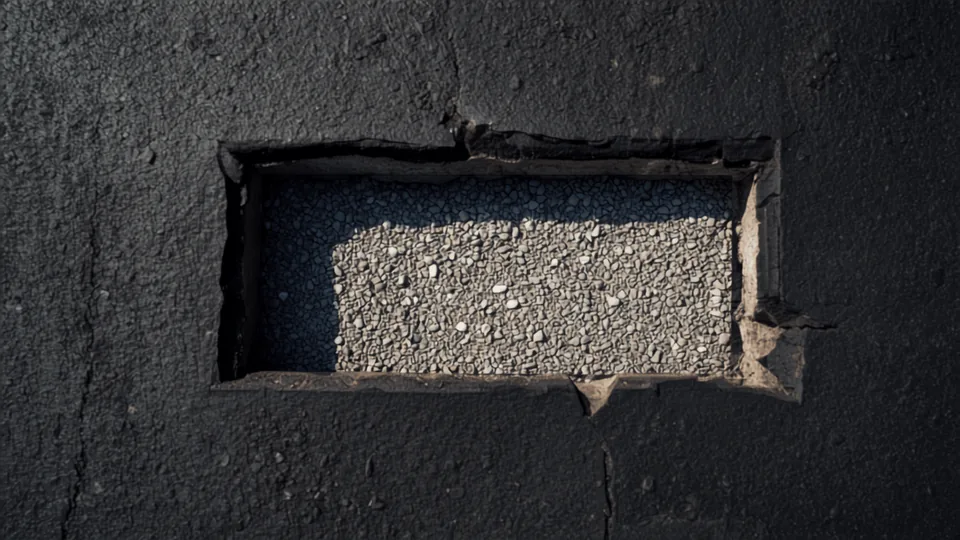
Taking out the old material is the visible part and the least important one. What distinguishes a rebuild from an expensive resurface is what happens in the window when everything is open.
- Removal and disposal of what was there, hauled off rather than buried on site.
- Correcting the shape of the ground, which is the one moment in the life of the property when the fall can actually be changed.
- Adding or replacing aggregate where it was thin, absent, or contaminated with soil that migrated into it over the years.
- Compaction in layers, so the supporting bed is uniformly dense rather than dense on top and loose beneath.
- Only then, paving, to a stated section.
The earthwork and the stone are the bulk of both the labor and the total. A proposal that moves straight from demolition to hot mix has left out the portion that decides how long the result lasts, and it will usually be the cheapest number in the stack for exactly that reason.
Drainage: the One Chance You Get
This is the part of a rebuild worth caring about most, and it is habitually the part nobody raises.
While a property is stripped back to bare ground, the fall across it can be altered. Once the new surface has cooled, it cannot — not without doing the entire job again. Changing the shape at that moment costs comparatively little because the machines are already there and the ground is already open. Changing it in three years costs everything a second time.
On this ground the argument for taking that seriously is stronger than it would be elsewhere, and less obvious. Where water leaves through fissures in rock rather than running off in sheets, a property that appears to drain well may be doing nothing of the sort. It can sit dead flat, dry within an hour of a storm, and still be a place where water gathers and lingers below the level anyone can see. Judging the fall by whether puddles form is unreliable here in a way that it is not on deep soil, which is why a rebuild is the moment to have somebody look properly rather than assume.
Rebuilding Part of It
A whole-surface rebuild is not always what is called for, and the question is worth asking out loud whenever the trouble is confined to one area.
A failed section can be saw-cut square, excavated to full depth, rebuilt from the ground up and tied back into what surrounds it. The seam will be visible. That is honest rather than defective, and anyone promising an invisible join is promising something the material does not do. The surrounding pavement carries on aging at whatever rate it was already aging at, which means a partial rebuild leaves a property with two different ages of surface — fine functionally, and worth knowing about in advance.
Partial work makes sense when a specific area failed for a specific reason: a trench that was backfilled and never properly compacted, a soft pocket between shelves of rock, a spot where something heavy stood for years. It makes considerably less sense when the whole property is the same age, was built to the same section, and is heading the same direction at the same speed. In that situation rebuilding a third of it is a payment on account.
Salvage, and What Is Worth Keeping
Not everything on a failing property is waste. Existing aggregate is frequently reusable in place once it has been regraded and recompacted, particularly where the failure was a drainage problem rather than a structural one. Material that comes out can sometimes be crushed and returned as base rather than hauled away and replaced with something purchased.
Neither is universal and neither should be assumed. Both are worth asking about directly, because the answer occasionally moves the total meaningfully, and because a contractor who has thought about it is a contractor who has looked at the site rather than priced from a spreadsheet.
Driveway replacement — FAQ
How do I know whether it needs rebuilding or just resurfacing? Read the cracking pattern. Fine lines running roughly parallel are usually surface ageing and are a resurfacing conversation. Interlocking cracks that look like scales, areas that flex or spring underfoot, and depressions that hold water after rain are all base messages, and no new asphalt on top will silence them. The test is whether the ground below is still carrying load.
What does a full replacement actually involve? Removing the old surface, then dealing with what is underneath rather than simply covering it: correcting the grade, replacing or adding stone where it is thin, compacting it properly, and only then paving. The excavation and the stone are the bulk of both the work and the cost. A quote that jumps from demolition straight to asphalt has skipped the part that determines how long the result lasts.
Can part of a drive be replaced instead of all of it? Often, and it is worth asking about when the failure is confined. A full-depth section can be cut out square, rebuilt and tied back in. The joint will be visible — that is honest rather than a defect — and the surrounding surface still ages at its own rate. Partial replacement makes sense when one area failed for a specific reason; it makes less sense when the whole drive is the same age and going the same way.
What happens to drainage during a rebuild? It is the part worth being most interested in, because a rebuild is the only realistic chance to change it. On ground where water leaves through fractured rock rather than running off in sheets, a drive can look flat and still be sitting in a place water collects. Regrading during a rebuild costs comparatively little; regrading afterwards means doing the job twice.
How many days does a rebuild take? Fewer than people expect for the machine work and longer than they expect overall, because the two halves run on different clocks. Tearing out and rebuilding the ground under a typical residential drive is a small number of working days. What stretches the calendar is weather, plant availability for the hot mix, and the gap that sometimes sits between the stone going in and the paving going down. Ask for the sequence rather than a single completion date, and ask what the property looks like in between.
More on paving in Springfield
Request a free written quote
Tell us the address and what you are looking to have done. Ask for the quote in writing with the thickness and the base work spelled out, so you can compare bids on the same terms.
Prefer to talk it through? Call (417) 815-7897.