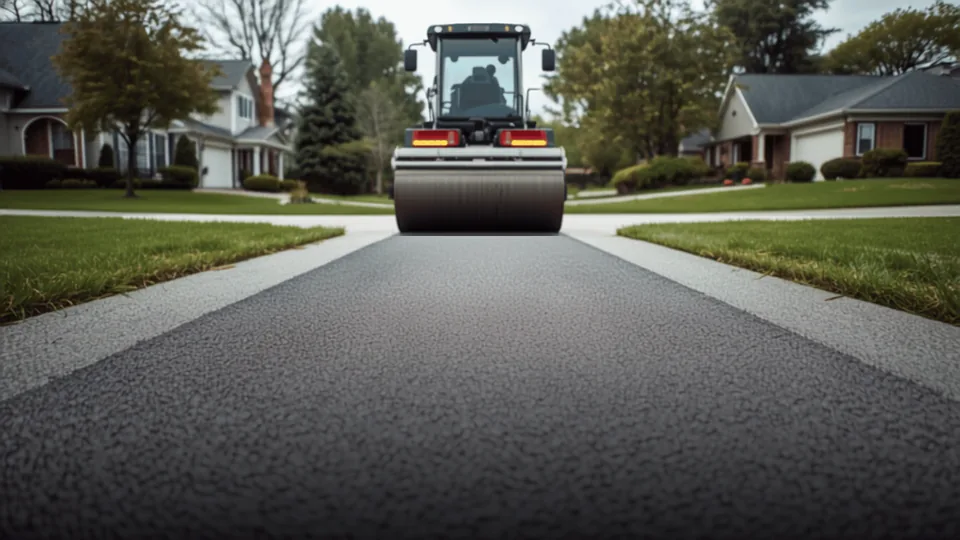
The Four Operations, and Why the Last One Is the Cheapest
Laying asphalt is four distinct jobs done in sequence, and the one everybody watches is the final one. Every decision that determines whether the result is still flat in fifteen years has already been made and buried by the time the black material shows up. Knowing the order is most of what a homeowner needs in order to compare two bids without being in the trade.
1. Cutting and shaping the ground
Dirt comes out and what remains is shaped. Shaping is not tidying — it fixes, permanently, where runoff is going to travel for as long as the surface exists. Get it wrong and no amount of good material above will rescue it.
On this plateau the excavation itself carries a local risk that flatter parts of the country do not have: the bucket can reach rock long before it reaches the intended depth. Refusal partway through a drive is common enough that it belongs in the conversation early, because the options at that point — breaking, building up rather than cutting down, or reshaping the run — all have different consequences and different numbers attached.
2. The stone, in layers, each one compacted
Crushed aggregate goes in and gets rolled in stages rather than dumped to full depth in one go. This layer is the structure. Asphalt is a flexible pavement, meaning it passes weight downward into whatever is beneath it instead of bridging across a span the way a poured slab does. So the stone carries the vehicle and the black material is a wearing jacket over it.
Around here that fact cuts in a helpfully cheap direction. Aggregate is quarried locally, which keeps haul distances short, so depth in the base is unusually good value compared with regions where every ton travels a long way. It is also the first item pared back when someone is racing to be the low bid, and the customer will not be able to see what was removed once the job closes.
3. A lower course of asphalt, where the build warrants one
Heavier builds get a coarser layer beneath the finish layer, and it contributes real structure. On a modest residential run it is occasionally skipped. Skipping it can be entirely correct; what is not correct is leaving it out silently, so that two bids appear to describe the same pavement.
4. The wearing course, placed hot and rolled immediately
The top layer arrives at temperature and has a limited window before it cools below the range in which it can be compacted. That single constraint explains the pace of a paving day. A crew moving fast is usually not cutting corners; they are racing the material.
Why the Season Has Hard Edges
Work runs from spring into fall, with both ends set by conditions rather than by a date on a wall. The limit is not preference and it is not scheduling. Hot mix is manufactured, and the plants that manufacture it close down for the coldest part of the year. While they are shut, the material simply does not exist to buy.
Ground temperature matters at least as much as air temperature, which surprises people. A bright, cold, still morning in early spring with frost barely out of the soil is a worse day to place a mat than a gray, mild, damp afternoon in October. Anyone offering to pave a driveway in the middle of winter here is worth one more question before a deposit changes hands.
Specify the Section, Not the Surface
There is no universally right thickness, which is exactly why a vague answer should not be accepted. The correct build depends on what is beneath and on what will actually roll across it — a drive that only sees two sedans is a different structure from one that takes a loaded trailer or a motorhome, and both differ again from one crossing a soft pocket between rock shelves.
What is not negotiable is that both numbers appear in writing before anyone agrees to anything: inches of compacted aggregate, and inches of asphalt above it, stated separately. And the counterintuitive part deserves saying flatly: a modest mat on a properly built foundation outlives a generous mat resting on inadequate ground, every time. If a bid has found savings somewhere, underneath is the worst place to have found them.
Three Different Jobs That Sound Alike
- Building from scratch — no existing surface, nothing to remove, and usually the heaviest earthwork because the ground has never been shaped for this purpose.
- Rebuilding — the old material is taken out, the ground beneath is corrected, and a fresh section goes in. What widespread interlocking cracking and persistent settling actually call for.
- Resurfacing — fresh asphalt over what is already there. Nothing is excavated and no aggregate is added. Legitimate only where what is underneath is genuinely still carrying load.
Resurfacing is where money disappears in this trade, and the failure is entirely predictable rather than bad luck. Placed over ground that has already stopped supporting the pavement, the new material reproduces the identical pattern in the identical places within a season or two, because whatever was moving down there never stopped moving. The purchase was a surface, and the surface was never what had failed.
The question worth putting to anyone proposing it is simply this: what makes you confident the ground below is still sound? Good answers to that exist. There ought to be one.
Where the Water Ends Up
Drainage is the item most often absent from a written quote and most often decisive in how long the pavement lasts. Locally it is also the one that hides best.
Over a heavy clay pan, poor grading is loud — standing water sits for a day or two after a storm and anyone can point at it. Over fractured limestone the water vanishes quickly, the property appears to shed it perfectly, and the movement continues out of sight through seams in the rock. Fines migrate, pockets slowly hollow out beneath the aggregate, and the pavement above them is fine until abruptly it is not. A quote that never mentions where runoff is meant to go is an incomplete quote, and on this ground the absence of a puddle proves very little.
The First Few Weeks
A new surface takes traffic within a day or so and stays soft for considerably longer than that. Softness is the material behaving correctly and not a defect. Practical consequences while it firms up:
- Vary where vehicles sit rather than parking on the same footprint daily, and avoid turning a steering wheel while stationary — that is what scuffs a young mat.
- Put a board under trailer jacks, jack stands and motorcycle kickstands. Concentrated point loads leave permanent dimples.
- Expect it to soften visibly in strong sun through the first summer. Still normal.
- Leave the sealing question alone for now. Coating a young surface locks in components that have not finished leaving it.
Turning Bids Into a Comparison
Four items convert a stack of totals into something that can actually be evaluated:
- Aggregate depth and asphalt depth, written as two figures.
- Whether existing material is removed or covered, and what removal adds.
- Runoff — fall, edge treatment, and the intended destination for water.
- The approach at the public road, which commonly falls to the road authority and should be confirmed for the specific address rather than assumed from the neighborhood.
For what actually moves the total on a residential job, the Springfield driveway cost guide works through the variables and why two honest bids can land a long way apart.
Asphalt paving — FAQ
How long should an asphalt driveway last around Springfield? Two decades is a reasonable ceiling on a surface that was built over a properly graded, properly compacted base and then maintained. The base sets that ceiling and nothing laid on top can raise it. Where drives fail early here it is almost never the mix — it is a section that was thin on stone, or a grade that sent water somewhere it could sit.
When is the paving season in southwest Missouri? Broadly spring through autumn, with both ends decided by weather rather than by the calendar. The hard constraint is supply: hot mix comes from a plant, plants shut down for the cold months, and when the plant is closed no amount of scheduling produces asphalt. Ground temperature matters as much as air temperature, so a bright cold morning can be a worse day to pave than a gray mild one.
How thick does the asphalt need to be? Ask for the whole section rather than a single number — inches of compacted stone base and inches of asphalt, written separately. The right depth depends on what the ground underneath is doing and on what will actually drive across it. On the shallow-rock ground common around here the base spec matters more than the mat, and a modest mat over a proper base outlasts a thick mat over soft ground every time.
How soon can it be driven on? Normally inside a day or so, though it will stay pliable for a good while after that. Softness at that stage is correct behavior rather than a fault. While it hardens, avoid parking in exactly the same spot every day, avoid turning the wheels of a car that is standing still, and put a board under any trailer jack or jack stand — a point load will dimple a young mat.
Can a new surface go straight over the old one? Sometimes, and only where the base below is genuinely sound. An overlay costs less because nothing is excavated and no new stone goes in. Put one over a base that has already failed and the same cracks come back along the same lines inside a season or two. The fair question to anyone quoting an overlay is what makes them confident the base is good — there are good answers to that, and there should be one.
Is a permit needed? It depends on the jurisdiction and on what is being done. Replacing a surface in kind is treated differently from adding pavement, widening a drive, or working on the approach where it meets the public road — that last one usually involves the road authority regardless of who else is. Rules differ between the City of Springfield and unincorporated Greene County, so confirm it for the specific address before work is scheduled.
More on paving in Springfield
Request a free written quote
Tell us the address and what you are looking to have done. Ask for the quote in writing with the thickness and the base work spelled out, so you can compare bids on the same terms.
Prefer to talk it through? Call (417) 815-7897.