Asphalt or Concrete, Decided by the Lot Rather Than the Brochure
The comparison usually gets argued as though one material were simply better. It is not that kind of question. On a property where the subgrade is stable, uniform and drains, both perform well and the choice comes down to budget, appearance and how long the owner intends to stay. The interesting cases are the ones where the ground is not uniform, which around here is most of them.
Thin soil over rock produces the specific condition that separates the two materials. Support underneath varies across short distances — solid shelf here, a softer seam three feet away — and any pavement laid across that boundary will eventually feel it. A rigid slab responds by cracking through, and the crack is structural, permanent and awkward to address without replacing a whole panel. A flexible surface responds by flexing, which postpones the failure, and when it does fail the damaged area can be cut out and rebuilt without touching the rest.
There is a second, quieter advantage that only shows up years later. Repair on a flexible surface is routine work with commonly available material, and the repaired area blends into its surroundings acceptably. Repair on a rigid one tends to be conspicuous no matter how carefully it is done. Owners planning to keep a place for a long time often care about that more than they expect to at the outset.
The Edge Is the Part That Fails First
Walk any tired residential surface and the damage will be concentrated along its sides. This is not coincidence and it is not poor material. It is geometry.
The middle of a drive is held up on every side by more of itself. The outermost few inches are held up on one side only, so every wheel that clips them is loading an unsupported overhang. That is a demanding thing to ask of a material designed to distribute weight downward into a bed of stone.
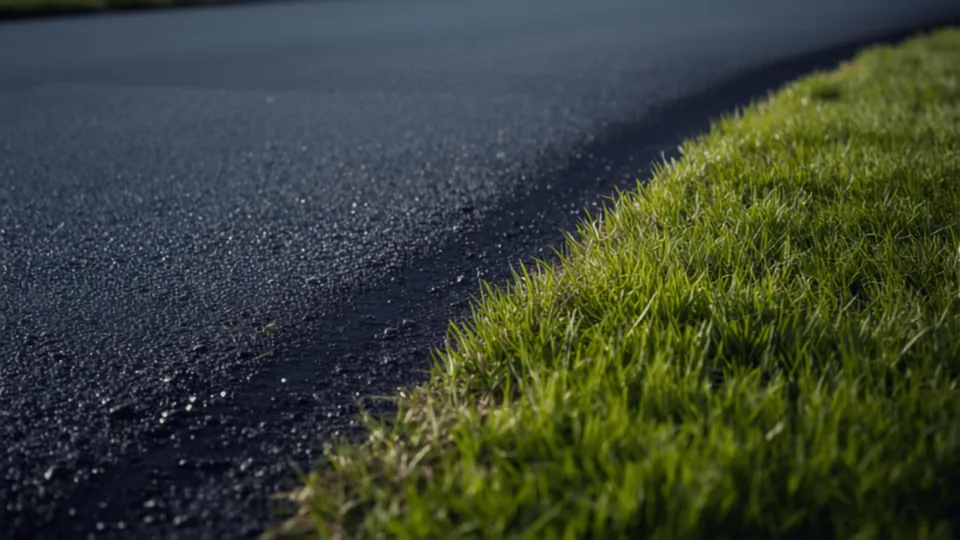
Edges survive when two things were done. First, the aggregate underneath was built wider than the pavement above it, so the supporting layer continues past the visible boundary and the overhang has something under it. Second, whatever sits alongside — turf, gravel shoulder, planted bed — was graded up to meet the pavement rather than left to fall away. A shoulder that has eroded into a step is an edge waiting to break off, and it is repairable with a shovel and some material long before it becomes repairable only with a saw.
Crumbling sides on a surface that is otherwise in good order almost always mean the stone stopped where the asphalt stopped.
The Approach at the Road
The strip where a private drive meets the public road does more work than any other part of it and gets the least thought. Everything that enters or leaves the property crosses it, including the occasional heavy vehicle the rest of the drive never sees — a delivery truck, a moving van, the trash truck swinging wide.
It is also the part most likely to belong to somebody else. Requirements at that transition are frequently set by whoever maintains the road, and those requirements are not the same inside the city limits as they are out in unincorporated territory. The correct time to find that out is while quotes are being gathered. Discovering it after the material has been ordered is expensive and entirely avoidable.
Slope Changes the Build, Not the Answer
Grade does not rule out a flexible surface. It changes what has to be specified.
Placing and compacting hot material on a run that falls sharply is a different sequence from doing it on the flat, and access for equipment has to be worked out in advance rather than improvised once a truck is idling at the bottom. Neither is unusual and neither is a reason to choose otherwise.
What genuinely matters on a steep run is interception. Water gathers speed as it comes down, and if nothing takes it off the surface before it reaches the bottom, it arrives with force at whatever is waiting there — the garage apron, the road, or an unprotected edge. The damage that follows shows up months afterwards at the low end and reads as though the pavement broke. It did not break. It was undermined. On steep ground the drainage detail is doing more work than the mix specification is.
The transition where a steep drive meets a level road deserves its own attention as well. Shaped carelessly, it scrapes the underside of ordinary vehicles, and that is a problem with no cheap fix once the surface has cured.
Gravel Drives on Acreage
A long gravel run outside the city is one of the more satisfying conversions in this trade, partly because years of traffic have often done some of the work already. Repeated loading compacts what is there, and where a usable stone layer has formed it can sometimes be incorporated rather than dug out and thrown away. That possibility is worth investigating on every rural job, and the assessment happens on the ground rather than from a description.
Three things decide whether it can be kept: how deep the compacted material actually goes, what the stone itself is, and whether the shape still throws water toward the sides instead of holding it along the middle. Any of those can rule it out. When all three hold, the saving is substantial and entirely real.
Long drives also raise questions that short ones do not. Where does a delivery vehicle turn around without reversing several hundred feet? Is there a point wide enough for two vehicles to pass? Where does water cross the run, and what is carrying it — because on a long fall the crossings matter more than the surface between them does. These are layout decisions and they are far cheaper to make on paper than to correct in pavement.
Width, and the Failure Nobody Predicts
Width is usually discussed as a matter of appearance. In practice it is a durability question, because the way a drive that is slightly too narrow fails is that drivers drop a wheel over the side, repeatedly, in the same place — and an unsupported overhang under a wheel is precisely the load it cannot take.
Where a vehicle is regularly backed down the whole length, sightlines matter as much as dimensions. Where boats, trailers or a motorhome are stored, the parking footprint deserves a heavier build than the running surface, for the same reason a lot needs more under its delivery lane than under its parking bays: the load is concentrated, repeated, and always in the same spot.
Deciding all of this before anything is ordered costs nothing. Deciding it afterwards means cutting into finished work.
Asphalt driveways — FAQ
Asphalt or concrete for a driveway here? Closer than most comparisons admit, and locally the ground decides more than the material does. Where the subgrade is stable and drains, either performs and the choice comes down to budget and preference. Where soil is thin over rock and water moves sideways rather than soaking away, asphalt tends to age more forgivingly because it flexes instead of cracking in slabs, and it is far cheaper to repair one section of.
Why does the edge always go first? Because an asphalt edge is unsupported by design — there is nothing beside it holding it up, so every tire that clips it is loading a cantilever. Edges last when the base is built wider than the mat so the stone continues past the asphalt, and when whatever sits alongside is graded up to meet it rather than falling away. Crumbling edges on an otherwise sound drive usually mean the base stopped where the asphalt stopped.
What about a steep drive? Slope changes the specification rather than ruling asphalt out. Steep runs want attention to how water is intercepted before it reaches the bottom, and where the drive meets the road the transition has to be shaped so vehicles do not scrape. Traction is a surface-texture question, not a material one. The steeper the run, the more the drainage detail is doing the work.
Can a gravel drive be converted to asphalt? Frequently, and it is often the least wasteful way to do it, because a gravel drive that has been in use for years may already have a compacted stone layer worth keeping. Whether it can be reused depends on depth, on the stone itself, and on whether the shape sheds water. That assessment happens on site — the honest answer before anyone has looked at it is that it depends.
How wide should a driveway be? Wide enough that nobody is dropping a wheel off the edge, which is the practical failure mode rather than an aesthetic one. Long rural drives on acreage outside the city often want a turnaround or a passing place more than they want extra width along the whole run. Where a drive is going to be regularly reversed down, sightlines matter as much as dimensions.
More on paving in Springfield
Request a free written quote
Tell us the address and what you are looking to have done. Ask for the quote in writing with the thickness and the base work spelled out, so you can compare bids on the same terms.
Prefer to talk it through? Call (417) 815-7897.