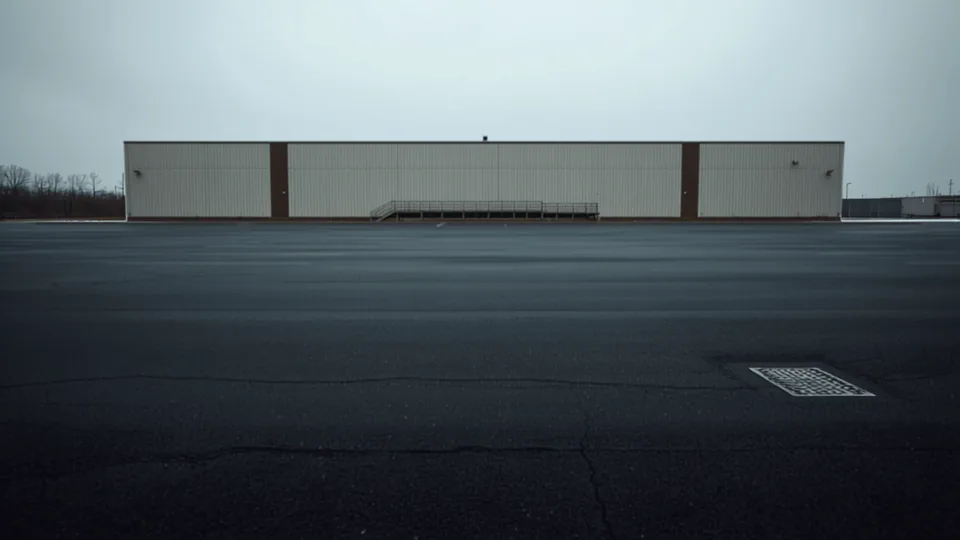
Load Is Not Spread Evenly, and Neither Should the Build Be
Walk a tired commercial property and the damage will not be distributed. It will be concentrated in four or five places, and those places are the same on nearly every site. Understanding why is the entire argument for specifying a lot in zones rather than as one uniform number.
Passenger vehicles are, structurally speaking, close to trivial. They are light, they spread their weight over four contact points, and they park in different spots. What breaks pavement is weight that is heavy, concentrated, and repeated in an identical footprint. That describes a very small proportion of any commercial site — and it describes exactly the areas that fail.
The waste enclosure
The most reliably damaged square on any commercial property. A collection vehicle arrives at the same spot on a schedule, plants stabilizing legs that concentrate enormous weight into a handful of small footprints, then lifts a full container. The forces involved dwarf anything else the site ever experiences, and they land in precisely the same places every week. A pad built to the same specification as the parking bays around it has a short and predictable life.
Delivery approaches and drive aisles
Every heavy vehicle entering the site follows the same path to the same door. That lane takes a hundred percent of the truck traffic while the bays either side take none of it. Building both to one average specification means over-building where nothing happens and under-building where everything does.
The entrance from the public road
Every vehicle crosses it, heavy ones included, and it usually turns while crossing — which adds shearing forces on top of the weight. It is also the part of a site most likely to sit within somebody else's jurisdiction, so requirements there should be established before the specification is finalized rather than after.
Wherever water gathers
Low points fail early because water sitting on a surface eventually gets into it. On this ground, low points can be harder to identify than usual: drainage through fractured rock means a site may shed water quickly and still be carrying it away below the surface, through seams that slowly remove fine material from beneath the structure. A property that never puddles is not automatically a property that is draining well.
Phasing, and Why It Costs More
Most sites cannot close, and most work can be sequenced so that part of the property stays in use throughout. That is standard practice rather than a favor.
It is not free, and the reason deserves stating because it is where comparisons between bids go wrong. Sequenced work takes more days overall, requires the equipment to be brought back repeatedly rather than once, and involves traffic management, signage and a written plan for which areas are usable when. A quote for a phased program and a quote for a single closure are two different products at two different prices, and comparing their totals as though they were the same purchase produces a conclusion that is simply wrong.
What can be sequenced depends on the layout. Sites with a single entrance, a single delivery route, or a legally required access path that cannot be interrupted have fewer options than sites with alternatives. That conversation belongs at the start, because it shapes the schedule and the number together.
Layout Decisions Belong Before the Paving
Marking out is separate work, done after the new surface has cured, and it should appear as its own line rather than being assumed into the total.
The layout itself, however, is worth settling much earlier — before anything is placed. Accessible spaces and their adjacent aisles have dimensional requirements that must be met on the ground, not approximately. Access routes for emergency vehicles have their own constraints. Both are far easier to accommodate while the surface is being designed than to correct once it exists, and correcting a dimension after the fact can mean cutting into finished pavement.
The practical question to ask early: how many spaces does this site need, of what kinds, and does the layout being priced actually deliver them?
What Belongs in a Commercial Specification
- The section for each zone, given as compacted aggregate depth and asphalt depth separately, with heavier areas identified and the reasoning stated.
- Drainage — where water is intended to go, what it crosses on the way, and what happens at any existing inlet or structure.
- Every transition: curbs, gutters, existing pavement being joined, and the entrance from the public road.
- The phasing plan, with which areas are unavailable during which stage.
- Marking, as a separate line with a layout attached.
A proposal that applies one rate per square foot across an entire property is averaging across areas that should not be averaged. It will be under-specified where the trucks go and over-specified where the cars sit, and the under-specified part is the part that determines when the site needs attention again.
Rebuild It, or Keep It Going
For a property that is aging but functional, the choice is rarely between doing everything and doing nothing. Sites can be maintained in sections indefinitely, with the areas that fail addressed as they fail and the areas that are fine left alone.
That approach makes sense while the failures stay isolated and predictable. It stops making sense when they start joining up, when the same locations return after being repaired properly, or when a year of attention starts approaching a meaningful share of what rebuilding the worst zones would cost. At that point the numbers usually favor a planned program over another year of reacting.
Either way, the honest version of this conversation includes what the property looks like in three years under each option, not just what the invoice says this month. Anybody willing to put that in writing has thought about the site rather than about the sale.
Commercial paving — FAQ
Why do parking lots fail in the same places every time? Because load is not spread evenly across a lot. Dumpster pads, delivery approaches and drive aisles take concentrated weight from heavy vehicles repeatedly and in almost exactly the same footprint, while the parking bays themselves see cars and little else. A lot built to one uniform specification throughout is over-built where nothing happens and under-built where everything does.
Can work be done without closing? Usually, by phasing it — sections are done in sequence so part of the lot stays usable throughout. That takes more days overall and more mobilisations, and it is worth saying out loud when quotes are compared, because a phased schedule and a single-closure schedule are different products at different prices. What can be phased depends on the layout and on where the fire lanes and accessible bays sit.
What is worth putting in the specification? The section, stated as compacted stone depth and asphalt depth separately; which areas are being built heavier and why; how drainage is being handled and where water is expected to go; and what happens at every transition — curbs, gutters, and the approach to the public road. A quote that gives a single square-foot rate for an entire lot is averaging across areas that should not be averaged.
Does striping come with the paving? It is separate work, done after the surface has cured, and it should be quoted as its own line rather than assumed. Layout is worth deciding before the paving rather than after, because accessible bays, access aisles and fire lanes have dimensional requirements that are far cheaper to plan for than to correct.
What does looking after a lot involve once it is down? Mostly two habits and one decision. The habits are walking it once or twice a year with an eye on the joints and the low spots, and closing openings while they are still narrow instead of after a winter has widened them. The decision is when a surface coat is genuinely earning its keep versus when the money would do more good under the pavement. A maintenance proposal that never mentions the second option is selling a product rather than answering a question.
More on paving in Springfield
Request a free written quote
Tell us the address and what you are looking to have done. Ask for the quote in writing with the thickness and the base work spelled out, so you can compare bids on the same terms.
Prefer to talk it through? Call (417) 815-7897.